The slides in words
The text of each slide, for reading, searching and screen readers. Select a slide's number to show it above.
Fire Safety and Utility Controls
Unit Objectives
- Explain role of CERTs in fire safety
- Identify and reduce potential fire and utility risks
- Describe CERT sizeup process
- Conduct basic sizeup for a fire emergency
- Explain basic safety precautions
- Identify hazardous materials
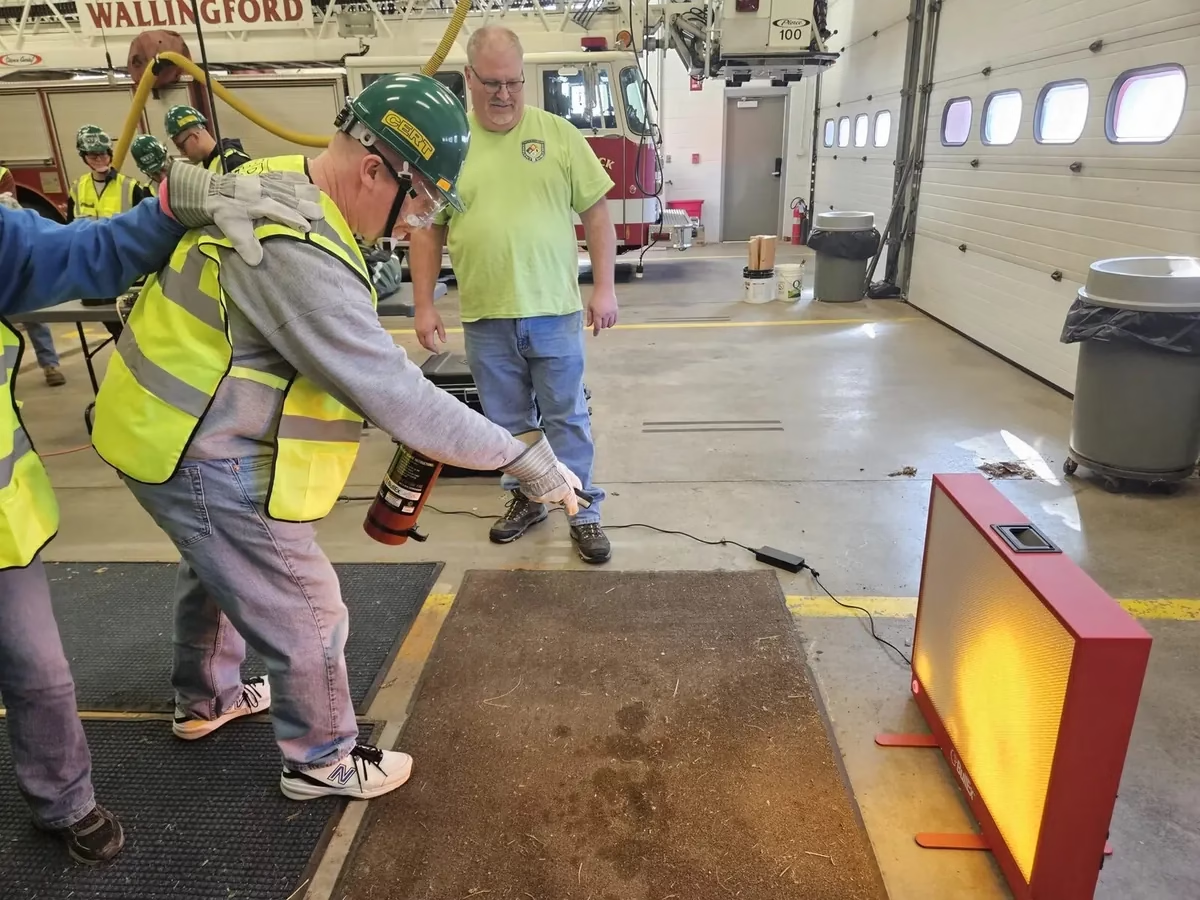
- Extinguish small fires using a fire extinguisher
Unit Topics
- Fire chemistry
- Fire and utility hazards in the home, workplace, and neighborhood
- CERT sizeup
- Fire sizeup considerations
- Firefighting resources
- Fire suppression safety
- Hazardous materials
Role of CERTs
- CERTs play very important role in fire safety by:
- Extinguishing small fires
- Preventing additional fires by removing fuel sources
- Shutting off utilities
- Assisting with evacuations, when necessary
CERT Priorities
- Help in emergencies before professional responders arrive
- Rescuer safety is number one priority
- Always work with a buddy
- Always wear safety equipment CERT Goal: Do the greatest good for the greatest number
The Fire Triangle
5 Classes of Fire
- A: Ordinary combustibles
- B: Flammable and combustible liquids
- C: Energized electrical equipment
- D: Combustible metals
- K: Cooking oils
Reducing Electrical Hazards
- Avoid the “electrical octopus”
- Don’t run cords under carpets
- Check for and replace broken or frayed cords
- Maintain appliances
Electrical Emergencies
- Know where power shutoffs are for:
- Appliances
- Circuit breakers
- Fuses
- Post shutoff directions next to all utilities
- Know procedures for turning power back on
Shutoff Procedures
- Fuse box with shutoff
- Circuit box with shutoff
Natural Gas Hazards
Natural Gas Hazard Awareness
- Install natural gas detector
- Install carbon monoxide detector in home
- Test batteries for natural gas and carbon monoxide detectors every month
- Change batteries every 6 months
- Locate and label gas shutoffs
- Have proper non-sparking tool
Gas Shutoff
- Locate and label gas shutoff valves
- If not automatic, know procedures for shutting off gas
Isolate, Eliminate, Separate) L.I.E.S.
- Always read labels
- Use L.I.E.S. storage procedures (Limit,
REMEMBER: CERT SIZEUP IS A CONTINUAL PROCESS
- 1. Gather Facts
- 2. Assess Damage
- 3. Consider Probabilities
- 4. Assess Your Situation
- 5. Establish Priorities
- 6. Make Decisions
- 7. Develop Plan of Action
- 8. Take Action
- 9. Evaluate Progress CERT Sizeup
CERT Fire Sizeup
- Helps responders decide:
- Whether to attempt to suppress a fire
- A plan of action
- Answers these questions:
- Do my buddy and I have the right equipment?
- Are there other hazards?
- Is the building structurally damaged?
- Can my buddy and I escape?
- Can my buddy and I fight the fire safely? Remember: The safety of individual CERT members is always the top priority
Firefighting Resources
- Portable fire extinguishers
- Wet standpipes
- Confinement
- “Creative” resources
Fire Extinguishers
- Water
- Dry chemical
- Carbon dioxide
- Specialized fire extinguisher
Extinguisher Rating/Labeling
- Labels show types of fires that extinguisher is used for:
- Class A fire ratings: 1A to 40A
- Class B fire ratings: 1B to 640B
- Higher number on label = greater amount of extinguishing agent
Examples of Labels
Test the extinguisher after pulling the pin
PULL AIM SQUEEZE SWEEP P.A.S.S.
Interior Wet Standpipes
- Usually in commercial buildings or apartments
- Work in twoperson teams when using wet standpipes
Safety of individual CERT members is top priority
Fire Suppression Safety
Fire Suppression Don’ts
- Don’t get too close
- Don’t try to fight a fire alone
- Don’t try to suppress large fires
- Don’t enter smoke-filled areas
Hazardous Materials
- Corrode other materials
- Explode or are easily ignited
- React strongly with water
- Are unstable when exposed to heat or shock
- Are otherwise toxic to humans, animals, or the environment through absorption, inhalation, injection, or ingestion
Identifying Stored Hazmats
The White Quadrant
- NFPA 704 Diamond White Quadrant:
- W: Shows unusual reactivity with water
- OX: Possesses oxidizing properties
STOP!
Orang
e Red White Red Red & White Red & White Blue Yellow White Yellow & White Black & White Hazmats in Transit
1203
3 Nam e Chemical Class Symbo lChemica l Number Chemical Class Symbo l UN and NA Placards
CERT Basic Training Unit 2: Fire Safety
and Utility Controls Remember! All hazardous material placards are a stop sign for CERTs Greater Than 1?
Unit Summary
- You should know:
- Keys to effective fire suppression
- CERT sizeup and fire sizeup considerations
- Classes of fire and types of fire extinguishers
- P.A.S.S.
- How to identify hazardous materials Always follow the safety rules established for CERTs – personal safety comes first!
Homework Assignment
- 1. Read unit to be covered in next session
- 2. Bring necessary supplies to next session
- 3. Wear appropriate clothes to next session
Course material: FEMA's CERT Basic Training (2019), in the public domain. For study only, not medical advice: in an emergency, call 911.